Are You Making This Common Mistake With Your Apartment's Aromatherapy Routine?
Apartment aromatherapy mistakes are often less about choosing the wrong scent and more about treating fragrance as if it were automatically harmless indoor air. In a compact apartment, a small room, limited air exchange, nearby sleeping areas, children or pets, and other household emissions can all change the context. The goal is not to make aromatherapy sound dangerous; it is to make the routine more deliberate, evidence-aware, and compatible with good indoor-air habits.
That distinction matters because essential oils are concentrated mixtures of volatile chemicals. A scent can be pleasant without being a proven health treatment, and a natural origin does not eliminate the need for sensible handling. The most useful question is therefore not “How can I make the apartment smell stronger?” but “What am I releasing, for how long, into what room, and what happens to it afterward?”
The overlooked mistake: treating fragrance as the same thing as clean air
The first conceptual mistake is assuming that a room that smells fresh is necessarily a room with better indoor air quality. The two are different measurements. Odor tells you that odor-active molecules are reaching your nose. It does not tell you whether particles, carbon dioxide, cooking emissions, cleaning chemicals, moisture, or other pollutants have been removed.
The U.S. Environmental Protection Agency's apartment guidance frames indoor-air improvement around three broad ideas: controlling pollution sources, increasing ventilation, and using air-cleaning devices when appropriate. It also notes that some problems in multifamily buildings are outside a resident's direct control. In other words, adding a fragrance source should not be confused with solving an existing indoor-air problem.
There is another useful nuance. Peer-reviewed research on common indoor fragrances shows that some fragrance compounds can be readily detectable by smell at concentrations that are still well below levels associated with sensory irritation in the studies reviewed. That means “I can smell it” is not a reliable shortcut for “this concentration is toxic.” At the same time, the research does not justify assuming that every fragrance exposure, every person, and every room condition is equivalent.
Mistake #1: assuming “natural” means non-toxic
Essential oils come from plants, but plant origin is not a safety classification. NCCIH describes aromatherapy as a complementary approach that commonly uses essential oils through inhalation or diluted topical application. Its consumer guidance also emphasizes that evidence for many proposed benefits remains limited. That is an important boundary: an oil can be pleasant, culturally familiar, or traditionally used without having strong evidence for a particular health outcome.
Safety also depends on route and exposure. The properties that make an essential oil aromatic are the same reason its constituents can enter the air. Concentrated oils can also cause problems when swallowed or misused topically. For apartment routines, the practical implication is simple: treat the oil as a concentrated chemical mixture, not as an ordinary household liquid.
If a household contains young children or pets, the issue becomes even more concrete. Essential-oil containers should not be treated like ordinary decorative objects. If accidental ingestion is possible, the relevant response is not to guess which oil is “mild”; it is to prevent access and follow poison-control or medical guidance when an exposure occurs.
Mistake #2: running a diffuser longer because the scent fades
A fading scent can tempt someone to increase runtime or add more oil. That is a behavioral loop worth interrupting. The nose adapts to persistent odors, so a person who spends a long time in the room may notice the fragrance less even though volatile compounds are still being emitted.
Recent research also reinforces the idea that diffuser emissions are dynamic. A 2026 study measuring monoterpenes from an essential-oil diffuser found short-term increases in measured indoor concentrations and reported that emission rates changed over time. The study was conducted in an office environment rather than a typical apartment, so it should not be treated as a direct measurement of every home. Its value here is narrower: it demonstrates why exposure should be understood as a time-dependent process rather than a fixed property of a bottle.
Decision logic: if the scent seems weaker only because you have been in the room for a long time, do not automatically interpret that as a signal to increase the amount released. If a room is small or poorly ventilated, the more conservative response is to reduce the source and restore outdoor-air exchange rather than continually increasing fragrance output.
Mistake #3: forgetting that terpenes participate in indoor chemistry
Essential-oil constituents are not chemically inert once they enter a room. A major peer-reviewed review of essential-oil-based household products describes these materials as sources of volatile terpenes in indoor air. It also explains that indoor oxidants can react with terpenes, producing secondary compounds such as formaldehyde and secondary organic aerosols under some conditions.
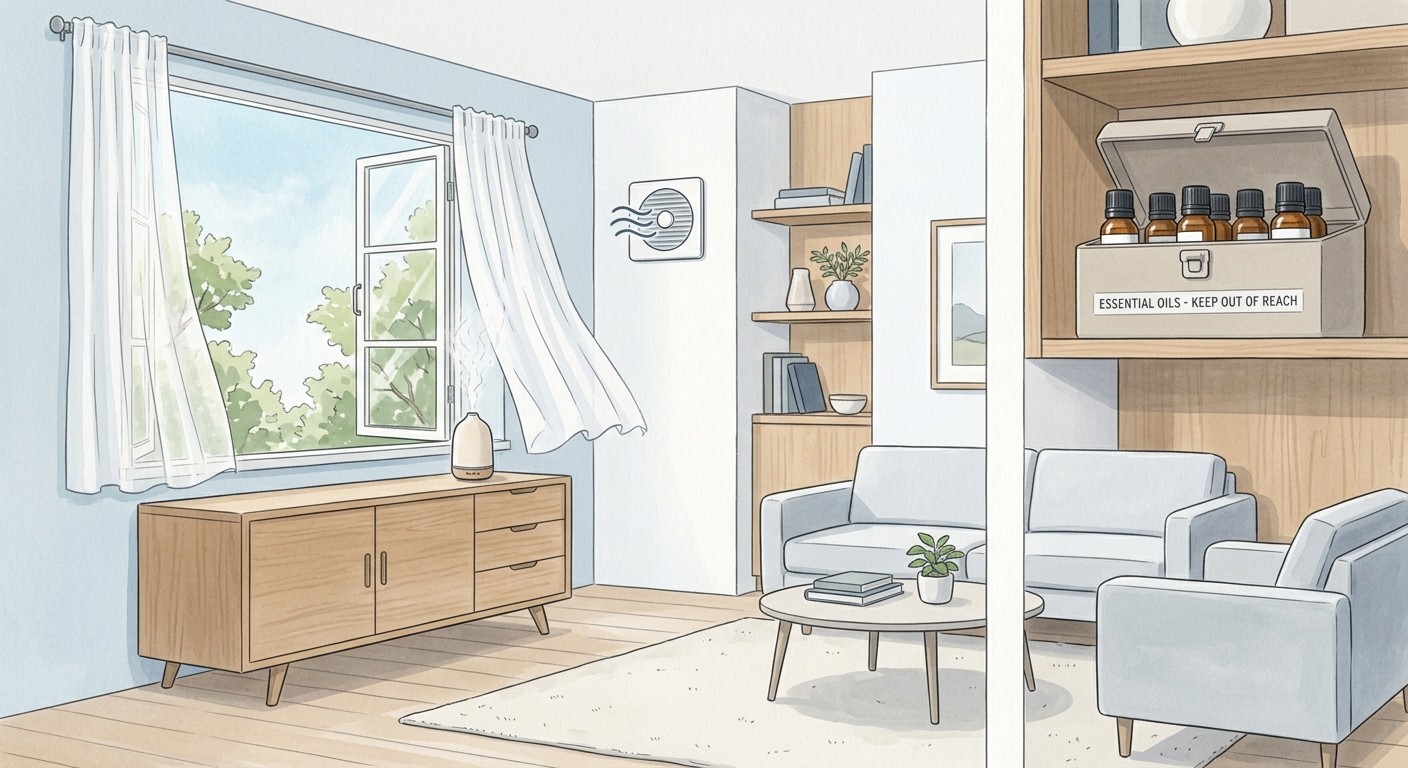
This does not mean that every diffuser session creates a dangerous concentration of pollutants. That conclusion would go beyond the evidence. Indoor chemistry depends on the compounds emitted, their concentration, room volume, air-exchange conditions, surface interactions, and oxidant levels. Other studies of common fragrances likewise emphasize uncertainty and the difficulty of translating controlled experiments into every real-world exposure.
The useful lesson is narrower and more practical: ventilation is not merely about making a smell disappear. It also changes how long emitted volatile compounds remain in the room. That is why a pleasant fragrance routine should coexist with ordinary indoor-air practices rather than replace them.
Mistake #4: ignoring apartment ventilation constraints
A detached house and an apartment do not necessarily exchange air in the same way. Apartment residents may have sealed windows, shared ventilation systems, limited exhaust capacity, mechanically supplied air, or building rules that affect what can be changed. EPA specifically notes that some apartment indoor-air problems require action by a building owner or manager rather than the individual resident.
Before treating ventilation as a simple “open a window” instruction, consider the actual room. If outdoor air is reasonably clean and weather conditions allow it, temporary natural ventilation can help dilute indoor pollutants. If the bathroom or kitchen has an exhaust fan that vents outdoors, using it for activities that generate indoor contaminants can also support source removal. If the building's ventilation system is malfunctioning, however, a resident may need to report the issue rather than improvise around it.
There is a trade-off here. More outdoor air is not automatically desirable under every condition: outdoor pollution, extreme weather, noise, security concerns, and energy use can affect whether natural ventilation is practical. The evidence-based principle is not “always open the window.” It is “maintain appropriate ventilation while considering the actual indoor and outdoor conditions.”
Mistake #5: treating ventilation and air cleaning as interchangeable
Another common apartment mistake is assuming that an air cleaner can simply compensate for any fragrance routine. EPA's air-cleaner guidance makes an important distinction: some filters are designed for particles, while other filter media can target gases. No air cleaner removes every pollutant, and filtration performance also depends on airflow, filter condition, and the pollutant being targeted.
This distinction matters because fragrance emissions are largely gaseous volatile compounds, while some secondary chemistry can involve particles. A device designed primarily for particles should not be described as a universal solution for fragrance-related VOCs. Conversely, gas-focused filtration should not be presented as a substitute for source control or ventilation.
Decision logic: if the problem is an identifiable source that can simply be reduced or stopped, source control is the clearest first step. If the concern is general indoor pollutant concentration, appropriate ventilation may help. If particles are also a concern, particle filtration can address that part of the problem. These approaches solve different problems and should not be collapsed into one “clean air” claim.
Mistake #6: overlooking storage, labeling, and contamination
Storage is easy to treat as an aesthetic detail because essential-oil bottles often look like decorative objects. It is better understood as part of chemical handling. ISO 210:2023 specifically addresses packaging, conditioning, and storage of essential oils, reflecting the fact that container and storage practices are part of maintaining the material appropriately.
Clear identification also matters. A bottle should not become an anonymous vial after the original label is discarded. Keeping the original identity and usage information available reduces the chance of confusing oils, using them in an unintended way, or forgetting what concentration or formulation is actually present.
“Pure” is also not a synonym for “safe.” Purity claims, botanical identity, concentration, intended use, and exposure route are different concepts. The article's evidence does not support making a universal claim that one marketing term guarantees a safer indoor-air outcome.
Mistake #7: making the apartment smell “clean” instead of fixing the source
Consider a simple counterexample. Suppose a bedroom has a persistent musty smell caused by moisture. Adding a pleasant essential-oil scent may change what the resident notices, but it does not remove the moisture source. The same reasoning applies to smoke, cooking emissions, strong cleaning odors, or a ventilation problem.
EPA's indoor-air framework is especially useful here because source control comes before relying on supplemental measures. If an odor points toward an identifiable source, investigate that source first. If the source cannot be corrected by the resident, documenting the problem and contacting the property manager may be more appropriate than continuously masking it.
This is also where the “non-toxic sanctuary” idea needs a reality check. No ordinary apartment is chemically empty. Cooking, furniture, cleaning products, outdoor air, human activity, and building materials all contribute to indoor chemistry. A sensible goal is not zero chemistry; it is reducing unnecessary emissions, maintaining reasonable ventilation, and avoiding avoidable exposure.
A practical apartment aromatherapy reset
The most useful routine is less about adding equipment and more about checking the sequence of decisions. The following checklist translates the evidence into ordinary apartment habits without assuming that every resident has the same ventilation system or exposure sensitivity.
- Identify the purpose. If the goal is simply a pleasant scent, do not describe the practice as a proven medical treatment. NCCIH notes that evidence for many aromatherapy claims is limited.
- Start with the source. If you are trying to hide smoke, dampness, cooking emissions, or a chemical odor, investigate the underlying source instead of adding more fragrance.
- Consider room volume. A small bedroom is not equivalent to a large, well-ventilated living area. A compact space can change how quickly an emitted substance accumulates.
- Consider air exchange. If the apartment has limited outdoor-air ventilation, avoid treating continuous fragrance release as harmless simply because the scent becomes less noticeable.
- Use ventilation appropriately. If outdoor conditions are suitable, outdoor-air ventilation can dilute indoor pollutants. If an outdoor-vented exhaust fan is available, it can support removal of indoor contaminants.
- Do not chase scent adaptation. If you stop noticing the smell after prolonged exposure, that is not evidence that more oil is needed.
- Keep storage controlled. Follow the principle of safe storage away from heat and direct light, preserve identifying labels, and use locked, out-of-sight storage when children or pets could otherwise reach the oils.
- Separate particles from gases. Remember that particle filtration and gas removal are different functions. Activated carbon filtration is discussed by EPA as a gas/VOC-oriented approach, not as a universal solution.
- Watch the occupants, not just the room. If someone consistently experiences irritation or breathing symptoms around fragrance, the routine may not be appropriate for that person.
- Escalate building problems. If the issue appears to involve a shared ventilation system, building defect, persistent dampness, or another condition outside your control, contact the building owner or manager.
Who this approach is for—and who should be more cautious
This evidence-led approach is useful for residents who enjoy fragrance but want to keep their routine proportionate. It is particularly relevant in small rooms, bedrooms, shared apartments, and spaces where several indoor sources operate at once.
It is not a substitute for individualized medical advice. People with known respiratory or fragrance sensitivities may respond differently from the general population. A peer-reviewed review of indoor fragrances found that the evidence around airway effects is complex and that typical indoor concentrations should not automatically be equated with severe toxicity. At the same time, a person who experiences reproducible symptoms around a fragrance does not need to prove that the fragrance is universally harmful before reducing exposure.
That distinction is important: population-level evidence describes averages and study conditions; household decisions concern a particular room and particular people. When the two conflict, avoiding an unnecessary fragrance exposure is often a simpler practical choice than trying to establish a universal safety threshold at home.
What the research does—and does not—establish
The evidence supports several fairly solid conclusions. Essential oils are sources of volatile compounds. Indoor ventilation affects pollutant concentrations. Terpenes can participate in indoor chemical reactions. Some essential oils can cause poisoning when misused or swallowed. Storage and labeling are meaningful safety practices. Air cleaners differ in whether they address particles or gases.
The evidence does not support equally broad conclusions that every essential-oil diffuser is dangerous, that every fragrance exposure is toxic, or that aromatherapy reliably produces a particular therapeutic outcome for everyone. The 2017 fragrance review, for example, found important uncertainty around long-term effects and around translating laboratory findings to typical indoor exposures. NCCIH likewise describes gaps in rigorous research for many aromatherapy uses.
This distinction is what keeps the subject useful rather than alarmist. The sensible target is not fear of every scented molecule. It is avoidance of unnecessary exposure, especially when the same comfort goal can be achieved with less continuous emission or better ventilation.
Frequently asked questions
Is a strong essential-oil smell proof that the air is unsafe?
No. Odor detection and toxicity are different concepts. Research on common indoor fragrances indicates that people can detect some compounds at concentrations below levels associated with sensory irritation in the studies reviewed. However, odor strength alone cannot establish the actual concentration or the response of a particular person.
Does ventilation make aromatherapy automatically safe?
No. Ventilation can lower indoor concentrations by bringing in outdoor air and removing or diluting indoor pollutants, but it does not make any substance universally safe. Outdoor conditions, building design, room size, and the source itself all matter.
Should I run a diffuser until I can no longer smell it?
That is not a sound rule. Your perception can adapt to a persistent smell, so reduced awareness does not necessarily mean that emissions have stopped. A 2026 diffuser study also illustrates that emissions can change over time, which is another reason not to treat scent perception as a dosing meter.
Can an air purifier remove essential-oil vapors?
It depends on the pollutant and the filtration technology. EPA distinguishes particle filtration from gas removal and notes that activated carbon or another gas-targeted filter is relevant to gaseous pollutants. No air cleaner removes every indoor pollutant, so filtration should not be treated as a universal substitute for source control and ventilation.
Does “100% pure” mean an essential oil is harmless?
No. Purity describes one property of a material; it does not establish that a concentrated oil is harmless by every exposure route. Essential oils can cause adverse effects when swallowed, misused topically, or otherwise handled improperly.
What if my apartment has poor ventilation?
Start with source control and determine what ventilation options the building actually provides. If the problem involves a shared or malfunctioning ventilation system, the resident may need the building owner or manager to investigate it. Do not compensate for poor ventilation simply by adding more fragrance.
Should essential oils be kept in the bathroom?
The key issue is not a universal room prohibition but appropriate storage conditions. ISO guidance addresses packaging, conditioning, and storage of essential oils. Keep oils identified and stored according to their intended handling requirements rather than treating them as decorative bathroom accessories.
Is aromatherapy proven to improve sleep or reduce stress?
Evidence varies by outcome and study design. NCCIH notes that rigorous research remains limited for several common aromatherapy claims. A pleasant scent may be personally relaxing, but that subjective benefit should not automatically be presented as a clinically established effect.
The takeaway: make the routine smaller, smarter, and evidence-aware
The common apartment aromatherapy mistake is not simply “using essential oils.” It is losing track of the difference between fragrance, indoor-air quality, and health claims. Once those categories are separated, the practical choices become clearer.
If the purpose is atmosphere, keep the fragrance routine proportionate to the room and occupants. If the purpose is to solve an odor problem, look for the source first. If ventilation is limited, avoid compensating by continually increasing fragrance output. If children or pets are present, prioritize secure storage. If filtration is being considered, distinguish gas removal from particle filtration. And if someone repeatedly experiences symptoms around fragrance, take that response seriously without assuming that it proves a universal hazard.
A peaceful apartment does not need to smell intensely scented to feel clean or restorative. The strongest evidence-supported habit is more ordinary: control unnecessary sources, maintain appropriate outdoor-air ventilation, handle concentrated materials carefully, and keep claims about aromatherapy within what the research can actually support. That approach leaves room for personal enjoyment of scent without turning fragrance into a substitute for healthy indoor-air practices.


Comments
Post a Comment