Is Your 'Fresh' Home Scent Harming Your Sanctuary? Unmasking Hidden Air Quality Risks.
A room can look spotless, smell like fresh linen, and still contain airborne pollutants you cannot see. That is the overlooked side of Home scent indoor air quality: the pleasant fragrance that makes an apartment feel welcoming may also introduce volatile chemicals into the air you breathe. The issue is not that every scented product is dangerous or that every synthetic ingredient causes harm. It is that fragrance can change indoor air chemistry, and the word “fresh” tells you very little about what is actually in the air.
Creating a peaceful home should involve more than covering unwanted odors. It should also mean understanding where those odors originate, how fragrance products work, and when the healthiest choice is to use less fragrance altogether. With a few practical changes, you can maintain a comfortable, inviting space without assuming that stronger scent equals cleaner air.
1. What a Pleasant Scent Can Hide in Your Indoor Air
Indoor air contains a mixture of gases and particles from cooking, cleaning, furnishings, outdoor pollution, and everyday household activities. Fragrance products add another possible source. Depending on the formulation, they may release volatile organic compounds, commonly called VOCs, into the surrounding air.
VOCs are a broad category of carbon-containing chemicals that can evaporate readily at ordinary indoor temperatures. They are not all equally hazardous. Some occur naturally, some are used in synthetic formulations, and their health implications depend on the particular compound, its concentration, exposure duration, and the person exposed.
Air fresheners, scented candles, plug-in diffusers, aerosol sprays, and fragranced cleaning products do not all produce the same emissions. A spray may release droplets and propellants, while a plug-in warmer releases fragrance compounds as the liquid heats or evaporates. Burning a scented candle also introduces combustion products, and incense produces smoke and fine particles.
Another important distinction is that fragrance and odor are not direct measurements of air quality. A product may make a room smell pleasant without removing particles or pollutants. Likewise, a room without a noticeable smell is not automatically free of harmful contaminants.
Why the size of your space matters
In a small apartment, studio, or bedroom, the same amount of a fragrance product can create a different exposure pattern than it would in a large, well-ventilated space. Air exchange, ceiling height, room layout, product output, and the length of time a product operates all affect the concentration of airborne substances.
If a scent seems overwhelming within minutes, that is a practical reason to stop using the product and ventilate the room when conditions allow. You do not need to identify every chemical before deciding that the intensity is uncomfortable.
2. How Synthetic Fragrances Can Affect Comfort and Health
The phrase “synthetic fragrance” describes a broad range of ingredients, not one specific chemical or uniform level of risk. A synthetic ingredient is not automatically more harmful than a natural one, just as a naturally derived ingredient is not automatically safe to inhale.
Some fragrance ingredients can irritate the eyes, nose, throat, or airways in susceptible individuals. Strong odors may also trigger headaches, nausea, or other symptoms for some people. Those reactions can vary considerably: one person may notice nothing, while another may find the same environment uncomfortable.
People with asthma or fragrance sensitivity may need to be particularly cautious. The relevant concern is not simply whether a scent is marketed as premium, botanical, or clean. It is whether exposure causes symptoms, what substances are released, and how often the person encounters them.
What happens when fragrance chemicals react with indoor air?
Some fragrance ingredients, including certain terpenes found in essential oils and other scented formulations, can react with ozone in indoor air. These reactions may generate secondary pollutants, including formaldehyde in some circumstances and ultrafine particles.
The extent of these reactions depends on the specific ingredients, ozone concentration, ventilation, and other environmental conditions. It would be inaccurate to assume that every scented product produces the same reaction or that every use creates a dangerous exposure. However, these chemical interactions are one reason fragrance emissions deserve consideration beyond their immediate smell.
Ventilation can reduce the buildup of some indoor contaminants, but it does not guarantee that every pollutant disappears. Outdoor air quality also matters. Opening windows may be useful when outdoor conditions are favorable, while filtered mechanical ventilation or appropriate air filtration may be more suitable during periods of smoke, heavy traffic pollution, or poor outdoor air quality.
Why repeated exposure deserves attention
A brief encounter with a scent is not equivalent to continuous exposure in an enclosed bedroom. A product that operates for hours may produce a different exposure pattern from a spray used once in a ventilated room. Multiple fragranced products can also contribute emissions at the same time.
This does not mean that every household must eliminate every scented item. It means that duration, frequency, and the number of sources are sensible factors to consider. If your home contains a plug-in air freshener, scented laundry products, fragranced cleaners, and a diffuser operating simultaneously, reducing the number of active sources is a straightforward way to simplify exposure.
3. The Common Home Fragrance Sources Worth Rethinking
Different products introduce fragrance into the home in different ways. Understanding those differences helps you decide which habits to change first instead of treating all scent sources as identical.
Aerosol sprays and automatic air fresheners
Aerosol air fresheners disperse product into the air, often combining fragrance with propellants and other formulation ingredients. Automatic dispensers repeat this process at intervals, which can make fragrance exposure less noticeable as a habit even when a product continues to operate throughout the day.
If you use a spray because cooking odors linger, address the cooking odor first. Remove food waste, clean the affected surfaces, and use an exhaust fan that vents outdoors when available. If an automatic dispenser is running in a room that already smells neutral, switching it off is a reasonable first step.
Plug-in fragrance warmers and reed diffusers
Plug-in products provide a relatively continuous fragrance source. Reed diffusers release volatile compounds through evaporation, even without heat or an electrical connection. Neither product type should be assumed emission-free simply because it does not spray or burn.
For people who want a low-fragrance home, continuous operation is an important decision point. If the scent remains noticeable all day, remove the product and assess whether the room actually needs any fragrance. If the problem is a persistent odor, investigate the source instead of increasing fragrance output.
Scented candles and incense
Burning candles and incense can generate fine particles and other combustion-related pollutants. The emissions depend on the material, wick or incense composition, burning conditions, and surrounding environment. Added fragrance can introduce further compounds, but eliminating fragrance does not eliminate combustion emissions.
This distinction matters because an unscented candle is not equivalent to an emission-free light source. If indoor air quality is the priority, an electric candle or ordinary lamp can create a similar atmosphere without a flame or smoke. If you choose to burn candles or incense occasionally, minimize the duration, avoid smoky conditions, and provide suitable ventilation.
Scented cleaning and laundry products
Fragrance can remain noticeable after cleaning or laundering. Some products may also release VOCs during application or drying. Laundry scent boosters, fabric sprays, and fragranced detergents can add to the total fragrance load of a household even though they are not typically marketed as air fresheners.
If your goal is to reduce fragrance exposure, look at the entire household routine. Replacing an air freshener while continuing to use several heavily fragranced products may produce a smaller change than expected. An unscented detergent or cleaner can be a useful alternative when it suits the task and works effectively for your household.
4. Understanding Home Scent Indoor Air Quality Through a Practical Comparison
The most useful comparison is not simply natural versus synthetic. It is the likely emission source, the way a product is used, and whether the product solves a real household problem. The table below provides a starting point for deciding what to reconsider.
How to use this comparison: If you want to reduce airborne emissions as much as reasonably possible, begin with products that burn, spray, heat, or release fragrance continuously. If you rarely use scent and have no related symptoms, occasional use may be a different exposure scenario from running several products all day. The table is a decision aid, not a claim that every product in a category carries an identical risk.
5. Natural Home Fragrance Is Not Automatically Non-Toxic
Botanical scents are appealing because they can evoke gardens, citrus groves, herbs, or fresh wood. Essential oils, dried flowers, and other plant-derived materials can fit into a thoughtfully designed home. However, “natural” describes an origin, not a complete toxicological assessment.
Essential oils contain concentrated volatile compounds. Depending on the oil and how it is used, those compounds may irritate sensitive airways, trigger symptoms, or participate in chemical reactions in indoor air. A diffuser that releases plant-derived molecules is still introducing airborne chemicals into a room.
Similarly, a product labeled “green,” “clean,” or “eco-friendly” is not necessarily fragrance-free, emission-free, or independently tested for every relevant indoor-air concern. Marketing language can describe a brand's positioning without providing enough information to assess inhalation exposure.
When a botanical scent may not be the right choice
If you experience asthma symptoms, migraines associated with odors, unexplained irritation, or discomfort around perfumes, do not assume an essential-oil blend will solve the problem. A fragrance-free environment may be a more suitable starting point than experimenting with additional oils.
If you simply enjoy occasional fragrance and do not experience symptoms, a conservative approach is to use less, for shorter periods, in an appropriately ventilated space. Keep products away from children and pets, follow the manufacturer's instructions, and do not ingest essential oils or apply concentrated oils to skin without appropriate guidance.
The trade-off is straightforward: reducing scent can mean giving up an immediate sensory ritual, but it also avoids adding that particular fragrance source to the room. For people who value scent as part of relaxation, non-airborne alternatives such as scented objects kept sealed when not in use may reduce continuous emissions, although they are not necessarily suitable for people with severe fragrance sensitivity.
6. Build a Peaceful Sanctuary Without Covering Up Odors
A calm atmosphere does not depend on filling a room with fragrance. Visual simplicity, comfortable lighting, clean textiles, and a consistent cleaning routine can create a welcoming environment without adding an unnecessary airborne scent source.
Start with odor removal, not odor masking
Unpleasant smells often point to something that needs attention. A musty closet may indicate excess moisture. A lingering kitchen odor may come from food residue, grease, or a poorly maintained waste container. A bathroom smell may be related to a drain, plumbing issue, or damp material.
Masking these odors can delay finding the cause. If a smell returns soon after you spray an air freshener, investigate the source. Clean the relevant surfaces, empty waste bins, dry damp items, and address leaks or moisture problems. Persistent mustiness or visible mold warrants attention to the underlying moisture rather than the addition of fragrance.
Use ventilation strategically
When outdoor air quality is good, opening windows or using an exhaust fan that vents outdoors can help remove indoor pollutants and odors. Kitchen and bathroom exhaust fans are especially useful when they are properly installed and maintained.
However, ventilation is not a universal solution. Outdoor smoke, high pollution levels, pollen, extreme temperatures, and humidity can make open-window ventilation less appropriate. In those circumstances, follow local air-quality guidance, maintain suitable HVAC filters, and consider a properly sized portable air cleaner with a high-efficiency particulate air (HEPA) filter for airborne particles.
A HEPA filter captures particles; it does not, by itself, reliably remove every gaseous fragrance compound. If gas removal is a goal, a device may need an appropriate quantity of activated carbon or another suitable sorbent. Performance depends on the device design, the type and amount of filter media, and maintenance. Avoid devices that intentionally generate ozone as an air-cleaning method.
Choose atmosphere cues that do not require fragrance
Warm lighting, breathable textiles, natural colors, uncluttered surfaces, and comfortable temperature can make a home feel inviting without changing its scent. A clean blanket, a tidy entryway, or a softly illuminated reading corner may contribute more to a relaxing atmosphere than a constantly running diffuser.
Houseplants can add visual interest and a sense of connection to nature, but ordinary houseplants should not be treated as a substitute for ventilation or a suitable air-cleaning system. Their strongest role in a low-fragrance sanctuary is often aesthetic rather than a reliable method of removing indoor pollutants.
7. A Practical Checklist for Lower-Fragrance Living
You do not have to redesign your entire home in one afternoon. A simple audit can identify the most obvious sources and help you make changes that fit your space, budget, and comfort.
Use this checklist room by room:
- ☐ Identify every air freshener, plug-in warmer, reed diffuser, scented candle, incense product, and essential-oil diffuser currently in use.
- ☐ Switch off unnecessary continuous fragrance devices and notice whether the room remains comfortable without them.
- ☐ Review fragranced laundry products, fabric sprays, and cleaning products rather than focusing only on items labeled as air fresheners.
- ☐ Find the source of recurring odors before trying to cover them with a stronger scent.
- ☐ Check for damp materials, leaks, musty storage areas, and waste containers that need cleaning.
- ☐ Ventilate when outdoor air conditions are favorable, using kitchen or bathroom exhaust systems where appropriate.
- ☐ Check HVAC filters and replace or maintain them according to the manufacturer's instructions.
- ☐ If using an air purifier, confirm whether its filter addresses particles, gases, or both.
- ☐ Consider unscented products when replacing household cleaners or laundry supplies.
- ☐ Keep at least one sleeping or resting space free from added fragrance if this improves comfort.
- ☐ Observe whether headaches, irritation, coughing, or breathing discomfort coincide with particular products or rooms.
- ☐ Store household chemicals safely and follow product labels rather than combining cleaning products.
A simple decision path for your next change
If you use a fragrance product every day simply because it has always been there, switch it off for a trial period and see whether you actually miss it. If the room remains pleasant, you have removed an unnecessary source without needing a replacement.
If you are trying to manage a recurring odor, identify and correct the cause first. If the odor persists despite ordinary cleaning, investigate moisture, drainage, ventilation, or other possible sources instead of increasing fragrance intensity.
If you have respiratory symptoms or strong fragrance sensitivity, prioritize a fragrance-free environment rather than switching from synthetic perfume to essential oils. If symptoms are severe, persistent, or include breathing difficulty, seek appropriate medical advice.
If you enjoy fragrance and do not notice adverse effects, decide whether occasional, limited use meets your needs. Keep in mind that the absence of noticeable symptoms does not prove that a product has zero emissions; it simply means that your personal experience has not identified an obvious problem.
If outdoor air is polluted, do not automatically open every window. Use local air-quality guidance and consider filtration suited to the pollutants of concern. Reducing indoor fragrance emissions can still be useful while you manage outdoor pollution separately.
8. Cautions, Exceptions, and Common Misunderstandings
Never assume that a natural, unscented, or “non-toxic” label guarantees that a product is harmless under every condition. Likewise, do not assume that all fragrance exposure causes illness. Product composition, dose, duration, ventilation, and individual sensitivity all matter.
Do not mix household cleaners to create a stronger odor-removing solution. In particular, mixing bleach with ammonia or acids can release dangerous gases. Follow label instructions, keep chemicals in their original containers, and seek urgent help if a suspected chemical exposure causes serious breathing difficulty or other severe symptoms.
Misunderstanding 1: If it smells clean, it must be clean
Fragrance can change how a room smells without removing the contaminants responsible for poor air quality. A fresh-linen scent does not establish that the room has fewer particles, less moisture, or fewer harmful gases. Cleanliness and air quality require attention to the actual conditions, not just the odor.
Misunderstanding 2: Every VOC is equally dangerous
VOCs vary widely in their chemical properties and health effects. The term alone cannot tell you whether a specific product poses a meaningful risk in a particular situation. It is more useful to consider available ingredient information, product use, ventilation, exposure duration, and recognized health guidance than to treat every VOC as identical.
Misunderstanding 3: Fragrance-free always means emission-free
A fragrance-free product may still contain ingredients that release VOCs or otherwise affect indoor air. Cooking, cleaning, furnishings, building materials, and outdoor air can also influence indoor conditions. Reducing fragrance is a practical step, but it is not a complete indoor-air management plan.
Misunderstanding 4: Opening windows always fixes the problem
Ventilation can help dilute some indoor pollutants, but its usefulness depends on outdoor conditions and the pollutant involved. When outdoor air is smoky or heavily polluted, opening windows may worsen exposure. In those cases, source control and appropriate filtration may be more useful than unrestricted ventilation.
Who should take extra care?
People with asthma, fragrance-triggered symptoms, or other respiratory sensitivities may find that reducing fragrance makes their environment more comfortable. Households with infants, older adults, or people who cannot easily leave a room may also benefit from avoiding unnecessary continuous emissions. These considerations do not establish that every fragranced product causes harm; they support a more cautious approach where exposure or symptoms are a concern.
Pets introduce another reason to use care. Some essential oils and fragrance ingredients can be harmful to certain animals, particularly if concentrated products are ingested, spilled on fur, or used in ways that create substantial exposure. Risks vary by species and substance. Keep products inaccessible, follow veterinary guidance, and do not assume a plant-derived ingredient is safe for every pet.
9. Frequently Asked Questions About Home Fragrance and Indoor Air
1. Can air fresheners reduce indoor air pollution?
Ordinary air fresheners are primarily designed to add fragrance or mask odors, not to remove a broad range of pollutants. Some products may alter or absorb particular odor compounds, but that does not establish that they remove particles or harmful gases generally. Identify the odor source, improve ventilation where appropriate, and use filtration designed for the specific contaminant when needed.
2. Are natural essential oils safer than synthetic fragrances?
Not necessarily. Natural and synthetic fragrance ingredients can both release volatile compounds, and their effects depend on the substance, concentration, exposure, and individual sensitivity. Essential oils are concentrated materials, and some can irritate the airways or be unsafe around particular pets. If you are sensitive to fragrance, a fragrance-free approach is generally a more direct way to reduce exposure than substituting one scent for another.
3. What is the best way to make an apartment smell fresh without air fresheners?
Start by removing trash, cleaning food residue, laundering washable fabrics as needed, drying damp areas, and addressing drains or moisture problems. Ventilate when outdoor air quality permits. Keep textiles clean and the room uncluttered. If an odor remains, investigate its source rather than covering it with perfume.
4. Do unscented candles improve indoor air quality?
An unscented candle avoids added fragrance but still produces combustion emissions when burned. If your goal is to reduce indoor particles and combustion products, an electric candle or ordinary lamp is a better alternative because it creates ambiance without burning wax or producing a flame.
5. Does a HEPA air purifier remove fragrance chemicals?
A HEPA filter is designed to capture airborne particles, not to remove all gases or VOCs. A purifier with suitable activated carbon or another gas-phase sorbent may help with some gaseous pollutants, depending on the amount and type of filter media and the operating conditions. Source control remains important because filtration is not a universal substitute for eliminating an unnecessary emission source.
6. Is a fragrance-free home completely free of indoor air pollutants?
No. Fragrance-free living reduces one potential source of emissions, but indoor air can still contain particles and gases from cooking, building materials, furnishings, cleaning activities, outdoor pollution, and other sources. Combine fragrance reduction with moisture control, appropriate ventilation, sensible cleaning practices, and suitable filtration where necessary.
7. How can I tell whether a fragrance product is affecting me?
Notice whether symptoms such as eye irritation, coughing, headaches, or breathing discomfort repeatedly occur during or after exposure to a particular product. If you suspect a connection, stop using the product, leave the affected area if needed, and improve ventilation when safe. A symptom diary may help you recognize patterns, but it cannot diagnose a condition or prove which chemical caused it. Seek professional advice for recurring symptoms and urgent help for severe breathing problems.
8. Do I need to eliminate every scented product in my home?
Not everyone needs the same level of restriction. If fragrance triggers symptoms or a household member is especially sensitive, a fragrance-free home may be the most practical choice. If no one notices adverse effects and you prefer occasional fragrance, reducing continuous use and avoiding unnecessary overlapping products is a reasonable middle ground. The key is to make an informed decision rather than assuming either complete elimination or unlimited use is right for every household.
10. Rethink What a Fresh Home Really Means
A peaceful home should support comfort without requiring a constant stream of added scent. Once you distinguish fragrance from cleanliness, the choices become easier: a lingering odor calls for investigation, smoky air calls for source control and appropriate filtration, and an overpowering perfume is a reason to reduce exposure rather than intensify it.
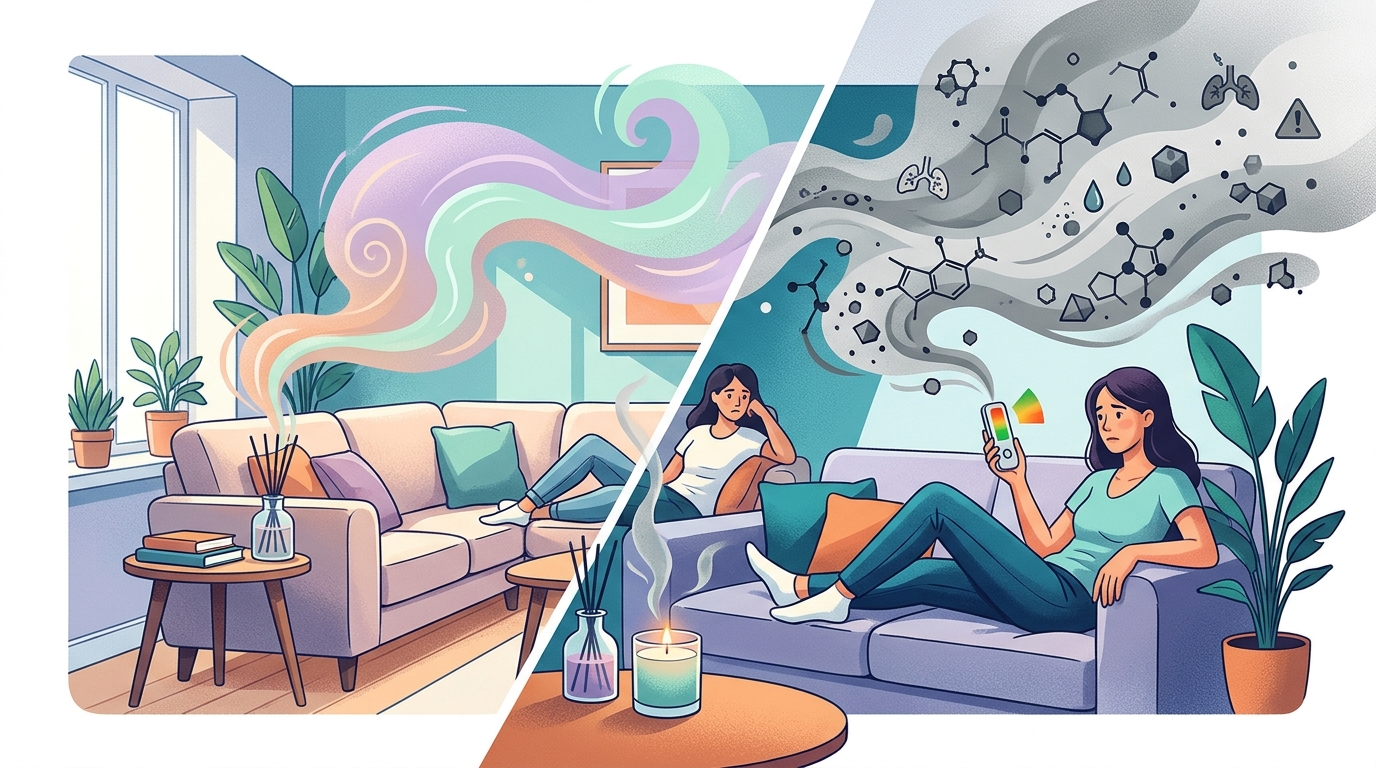
The most useful approach to Home scent indoor air quality is layered rather than absolute. First, remove avoidable sources such as unnecessary sprays, continuously running plug-ins, and routine burning of scented materials. Next, clean the surfaces or materials responsible for unwanted odors, control moisture, and ventilate when outdoor conditions are suitable. Finally, consider whether any fragrance is needed at all, remembering that natural ingredients can also produce airborne emissions.
There are legitimate differences between households. Someone who enjoys an occasional scented object may make a different decision from someone whose asthma or migraines are triggered by fragrance. Someone living near heavy traffic may need to prioritize outdoor pollution management, while someone dealing with musty air may need to address a leak or ventilation problem. No single fragrance rule replaces these specific considerations.
For a more comfortable sanctuary, judge household choices by what they accomplish, how they affect the air, and whether they introduce avoidable exposure. A home does not have to smell like a flower shop, a luxury hotel, or freshly washed linen to feel cared for. Sometimes the most reassuring sign of a well-maintained room is simply that it feels clean, breathable, and comfortable without needing to smell like anything at all.


Comments
Post a Comment