The Hidden Toxins Lurking in Your 'Fresh' Home Scents: What You Need to Know
“Fresh” is not the same thing as clean. That distinction is easy to miss when a room spray, plug-in, candle, diffuser, or scented cleaner turns a stale room into something that smells like linen, citrus, pine, or a forest after rain. The appeal is immediate: the nose receives a signal that we associate with cleanliness. But non-toxic home scents are better understood as an indoor-air question than a fragrance-marketing question. What matters is not simply whether a scent smells natural or pleasant, but what enters the air, what happens to those chemicals after they are released, how long they remain, and whether the source also produces particles or combustion byproducts.
This does not mean every fragranced household product is inherently dangerous, nor does it mean that a synthetic ingredient is automatically worse than a plant-derived one. Fragrance chemistry is complicated, exposure varies, and individual responses differ. The useful question is narrower and more practical: when the goal is a comfortable home with cleaner indoor air, which scent sources add unnecessary chemical or particle pollution, and what can be changed first?
The “Fresh” Feeling Can Hide an Air-Quality Problem
Odor and cleanliness are not the same measurement. A fragrance can cover an unpleasant smell without removing whatever caused it. A deodorizing product can also release its own volatile compounds while changing the way the room smells. This distinction matters because indoor air is a chemical environment, not an empty background waiting for a pleasant scent.
The U.S. Environmental Protection Agency explains that volatile organic compounds, or VOCs, are gases released by certain solids and liquids and that many household products can be sources. The concentration of many VOCs is consistently higher indoors than outdoors, although the actual concentration depends on the building, ventilation, products, and activities involved. Some VOCs have short-term effects, while others have longer-term health concerns. The term “VOC,” however, is a broad category rather than a synonym for “toxic.” Different compounds have different properties and hazards.
That nuance is important when discussing fragrance. A room should not be labeled unsafe merely because a fragrance contains VOCs. At the same time, the absence of an immediate symptom does not prove that adding fragrance has improved air quality. The sensible starting point is to distinguish between odor perception, chemical emissions, and actual exposure.
Where the Hidden Chemistry Comes From
Fragrance products can contain mixtures of chemicals that evaporate into indoor air. Some ingredients are deliberately added for scent, while others may serve as solvents, carriers, stabilizers, or other formulation components. On consumer packaging, the fragrance portion may be represented collectively rather than as a complete list of every individual aromatic compound.
The American Lung Association notes that fragrances can contain hundreds of chemicals and that many fragrance chemicals are VOCs. It also emphasizes an important point that is sometimes lost in “natural versus synthetic” arguments: both naturally sourced and manufactured fragrance materials can release chemicals into indoor air.
Research provides a concrete illustration. A peer-reviewed chamber study examining 30 air fresheners and deodorizers found substantial variation in VOC emission rates among the tested products. The study also reported that fragrance accounted for a major part of measured total VOC emissions from the tested indoor air-freshener products. These results do not establish that every commercial air freshener produces the same emissions, but they demonstrate why the label “air freshener” tells us very little about the actual quantity or composition of emissions.
A separate peer-reviewed study of gel-type air fresheners sold in the Korean market detected several VOCs in testing, including compounds such as toluene, ethylbenzene, xylenes, and benzene in the headspace of some products, as well as limonene and linalool. The study is useful as evidence that air-freshener emissions can contain multiple chemical constituents; it should not be read as a claim that every product contains every compound detected in that particular experiment.
Why “Natural” Does Not Automatically Mean Non-Toxic
One of the most persistent misconceptions about home fragrance is that “plant-based,” “botanical,” or “essential oil” automatically means chemically inactive. It does not. Essential oils are concentrated mixtures of volatile compounds. Their plant origin tells you where the ingredients came from, not whether those ingredients evaporate, react with other indoor pollutants, or affect sensitive occupants.
For example, compounds such as limonene and linalool are common fragrance materials and can be associated with natural sources. They can also participate in atmospheric chemistry. EPA guidance notes that some air fresheners, cleaning products, and fragrances with pine or citrus scents can react with ozone indoors to form particulate matter and other pollutants, including formaldehyde.
This is one reason the phrase “clean scent” can be misleading. A scent may feel clean while its chemistry is still active in the room. The useful distinction is not natural versus chemical—everything material is chemical—but source, composition, emission, reactivity, and exposure.
Burning Adds a Second Problem: Particles
Plug-ins, sprays, and reed diffusers primarily raise questions about chemical emissions. Candles and incense can add another layer because combustion creates particulate matter and other byproducts.
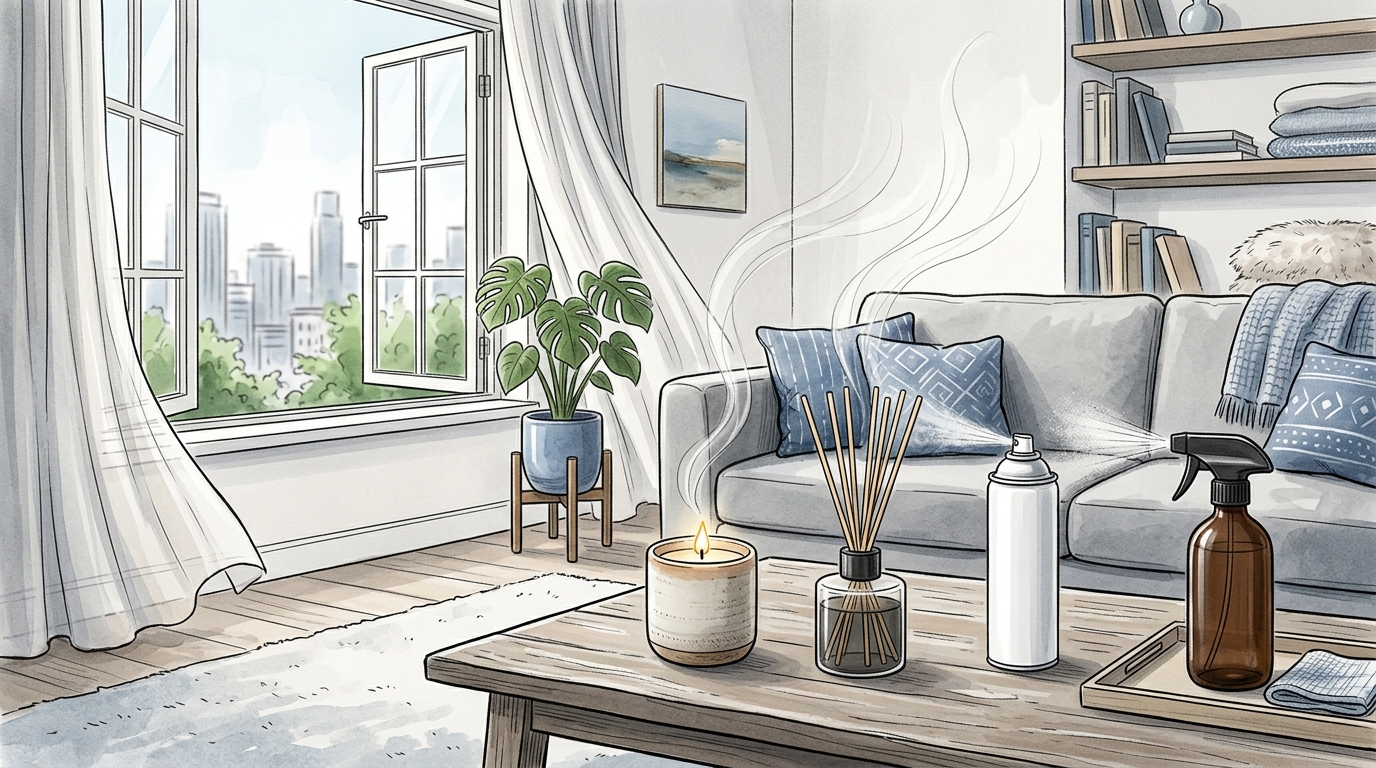
EPA identifies combustion activities, including burning candles, as indoor sources of particulate matter. Fine particles are small enough to penetrate deeply into the respiratory system, and exposure can be more concerning for some groups, including children, older adults, and people with certain heart or lung conditions.
Incense deserves separate attention because its purpose is often to produce an intentionally strong aromatic plume. An EPA literature review found that incense smoke can be a substantial source of indoor particulate emissions. This does not mean that a single occasional use produces the same exposure as frequent burning in a poorly ventilated room. Frequency, duration, room size, ventilation, and the amount burned all matter.
The practical implication is straightforward: if the goal is specifically to improve indoor air quality, replacing a scented aerosol with a burning fragrance is not necessarily a step toward cleaner air. You have changed the type of emission rather than eliminated the source.
What Actually Matters When Assessing a Home Scent
Instead of asking whether a product is “clean,” use a short decision framework. This is more reliable because marketing terms often compress several different questions into one attractive label.
The Priority Order: Remove, Ventilate, Then Filter
The strongest practical lesson from indoor-air guidance is that a filter should not be treated as permission to keep adding pollutants. EPA describes source control and ventilation as the most effective primary approaches, with filtration serving as a supplement.
That creates a useful decision sequence.
If the scent source is unnecessary, remove or reduce it first. If a room smells because of a garbage bin, damp fabric, cooking residue, pet area, or drain problem, address that source rather than continuously masking it.
If the source cannot immediately be removed, improve ventilation when conditions allow. Bringing in clean outdoor air can dilute indoor pollutants. Ventilation is not equally practical in every season, building, or outdoor-air situation, so the relevant question is whether outdoor air is actually cleaner and whether the building can exchange air effectively.
If source control and ventilation are insufficient, filtration can supplement them. A portable air cleaner can reduce some airborne pollutants, but its effectiveness depends on the pollutant, filter technology, airflow, room size, and maintenance. EPA also cautions that air cleaners cannot remove every pollutant.
This hierarchy matters because a particle-focused filter is not a universal solution for gaseous fragrance chemicals. Some filtration technologies include activated carbon or other sorbent materials that can address certain gases, but capacity varies. A device that is excellent for particles should not automatically be assumed to remove every VOC in a room.
How to Create a Lower-Emission Scent Routine
A calmer approach to home fragrance does not require turning a home into a scent-free laboratory. It means separating the desire for atmosphere from the assumption that more airborne fragrance equals a cleaner room.
- Identify the actual odor. Before adding a fragrance, look for the source. Check waste containers, textiles, food residue, drains, damp areas, smoke, and cleaning residues.
- Remove what can be removed. Cleaning, drying, laundering, and proper waste handling address the cause rather than merely covering it.
- Reduce continuous fragrance. A product that releases fragrance all day creates a different exposure pattern from a brief, occasional scent.
- Avoid using fragrance to compensate for poor ventilation. A room that repeatedly becomes stale may need better air exchange or investigation of an underlying source.
- Treat essential oils as concentrated fragrance materials. Their botanical origin does not eliminate the need to consider volatility, reactions, and individual sensitivity.
- Be especially cautious with combustion. Candles and incense can add particulate pollution, so they should not be treated as equivalent to passive scenting.
- Use filtration as backup, not camouflage. If an air cleaner is used, maintain it according to its instructions and understand what its filter is designed to capture.
Common Exceptions and Trade-Offs
There is no single “perfect” home-fragrance rule for every situation. A person living in a well-ventilated home who occasionally uses a small amount of fragrance may have a very different exposure profile from someone using several continuously emitting products in a small bedroom.
Likewise, eliminating every odor is not always the correct objective. Cooking produces odors but is a normal household activity; the more relevant concern may be controlling cooking emissions with ventilation. A bathroom may have a persistent odor because of a plumbing or moisture problem, where adding fragrance could delay attention to the underlying issue. A smoke odor may require source removal and cleaning rather than another scent.
There is also a trade-off between ventilation and outdoor conditions. Opening windows is useful only when outdoor air is reasonably suitable and the building can benefit from the exchange. During wildfire smoke, severe outdoor pollution, or other episodes of poor outdoor air, simply opening windows is not a universal answer. In those circumstances, source reduction and appropriately selected filtration can become more important.
For people who experience headaches, irritation, coughing, wheezing, or other symptoms around fragranced products, the threshold for reducing exposure may reasonably be lower. The American Lung Association identifies people with asthma, allergies, COPD, migraines, and chemical sensitivities among groups who may experience stronger reactions. Persistent or concerning symptoms should be discussed with an appropriate healthcare professional rather than attributed to a fragrance without evaluation.
Practical Action Checklist for a Fresher, Lower-Emission Home
- ☐ Find the odor source before adding another scent.
- ☐ Remove trash, damp materials, residue, or other identifiable odor sources promptly.
- ☐ Consider fragrance-free versions of routine household products when fragrance is unnecessary.
- ☐ Reduce the number of continuously emitting fragrance sources in small rooms.
- ☐ Avoid assuming “natural” means chemically inert.
- ☐ Remember that candles and incense add combustion particles as well as fragrance.
- ☐ Ventilate with clean outdoor air when conditions permit.
- ☐ If using an air cleaner, match the technology to the pollutant and maintain the filter.
- ☐ Do not use an ozone-generating air cleaner as a shortcut for fragrance removal.
- ☐ If someone repeatedly develops symptoms around fragranced products, reduce exposure and seek appropriate medical advice for persistent symptoms.
Who Benefits Most From Going Fragrance-Light?
A fragrance-light home is particularly relevant when the household has occupants who notice symptoms around scented products, when bedrooms are small and poorly ventilated, or when many different fragrance sources are used simultaneously. It can also be useful simply when the household's objective is cleaner indoor air rather than a stronger ambient smell.
That does not mean every person needs to eliminate every scented product. The evidence supports a more measured conclusion: unnecessary sources can be reduced, especially when the purpose of the fragrance is only to mask an odor. People who tolerate fragrance without symptoms may make different household choices from people who experience irritation or respiratory symptoms. The decision should follow the household's actual priorities and exposure pattern rather than a universal “natural is safe” or “all fragrance is toxic” rule.
FAQ: Non-Toxic Home Scents and Indoor Air
1. Does “non-toxic” mean a fragrance has zero VOCs?
No. “Non-toxic” is not a standardized scientific description of a complete indoor-air exposure profile. A fragrance may contain volatile compounds even when its marketing emphasizes natural, plant-based, clean, or green characteristics. The more useful questions are what compounds are emitted, at what concentration, for how long, and under what ventilation conditions.
2. Are essential oils automatically safer than synthetic fragrances?
Not automatically. Essential oils are concentrated mixtures of volatile plant compounds. Some can contribute to indoor VOCs and can react with other substances in indoor air. Their origin is relevant to formulation, but it does not by itself establish a particular indoor-air safety profile.
3. Can an air purifier remove fragrance chemicals?
It depends on the pollutant and the cleaner. Particle filters are designed primarily for particles, while gaseous pollutants may require sorbent materials such as activated carbon. Even then, performance depends on the amount and type of sorbent, airflow, pollutant concentration, and filter condition. EPA therefore presents filtration as a supplement to source control and ventilation rather than a universal replacement.
4. Are scented candles a type of non-toxic home scent?
The phrase “non-toxic” should not be used to erase the combustion issue. Burning a candle can generate particulate matter and other combustion products. If the priority is minimizing indoor particle pollution, not burning a scent source is a more direct source-control choice than relying on the candle's fragrance ingredients alone.
5. Why can a room smell clean while its air is not cleaner?
Smell is a sensory signal, not a measurement of pollutant concentration. A fragrance can mask an unpleasant odor while adding volatile chemicals to the air. The original odor source may remain underneath the fragrance. That is why source identification and removal are more informative than judging air quality by smell alone.
6. Is “low VOC” enough to identify a healthier fragrance?
No. EPA notes that total VOC levels do not by themselves establish safety because individual VOCs can differ substantially in toxicity. In addition, regulatory definitions of VOCs can be based on outdoor ozone formation rather than indoor health risk. A “low VOC” statement therefore needs context rather than automatic interpretation as “safe.”
7. What should I do if fragrance causes coughing or irritation?
First, reduce or stop exposure to the suspected product and improve ventilation when outdoor conditions permit. If symptoms are significant, persistent, recurrent, or involve breathing difficulty, seek appropriate medical advice. Do not assume that a particular ingredient is responsible without evaluation.
8. Is fragrance-free always necessary for a healthy home?
Not necessarily for every household. Fragrance-free choices can reduce one avoidable source of airborne chemicals, and they may be especially useful for people who are sensitive to fragrances. But indoor air quality also depends on combustion, moisture, building materials, cleaning products, outdoor pollution, ventilation, and other sources. Fragrance is one piece of a larger indoor-air system.
What “Clean Aromatherapy” Should Mean in Practice
If aromatherapy is part of a home's atmosphere, a useful interpretation of “clean” is not that a bottle contains only ingredients with attractive natural-sounding names. It is that the household understands the trade-off between scent and exposure. A clean approach asks whether the scent is necessary, how it is released, whether it burns, whether the room is ventilated, and whether anyone in the household reacts to it.
That reframes aromatherapy from a product-label contest into an indoor-environment practice. A small, occasional scent in a well-ventilated space is not the same exposure scenario as several continuous fragrance sources operating in a closed bedroom. A diffuser is not the same emissions source as a candle. A fragrance-free room is not automatically healthy if it has mold, smoke, high particle levels, or inadequate ventilation.
The Bottom Line: Freshness Is Not the Same as Cleaner Air
The evidence points to a practical synthesis rather than a blanket verdict on every home-fragrance product. Fragranced products can release VOCs; some fragrance compounds can participate in indoor chemical reactions; and burning candles or incense adds a particulate-emission pathway. At the same time, not every VOC has the same hazard, not every exposure produces symptoms, and product emissions can vary widely.
For a household trying to create genuinely cleaner indoor air, the most defensible order of priorities is therefore simple: identify unnecessary sources, reduce or remove them, ventilate with clean outdoor air when appropriate, and use filtration as a supplement when it addresses the relevant pollutant. If scent is still desired after those basics are handled, the goal should be moderation and informed use rather than assuming that “fresh,” “natural,” or “non-toxic” on a label settles the science.
A room does not become healthier because it smells stronger. In many cases, the more meaningful version of freshness is the absence of the odor source in the first place—and the quiet, unremarkable air left behind when there is less unnecessary chemistry to mask it.


Comments
Post a Comment